Bubble Vocab: Bubble Word Jam
- 4.9
- Rating
- 10.00K
- Installs
- Free
- Price
 Analysis by App-foxy
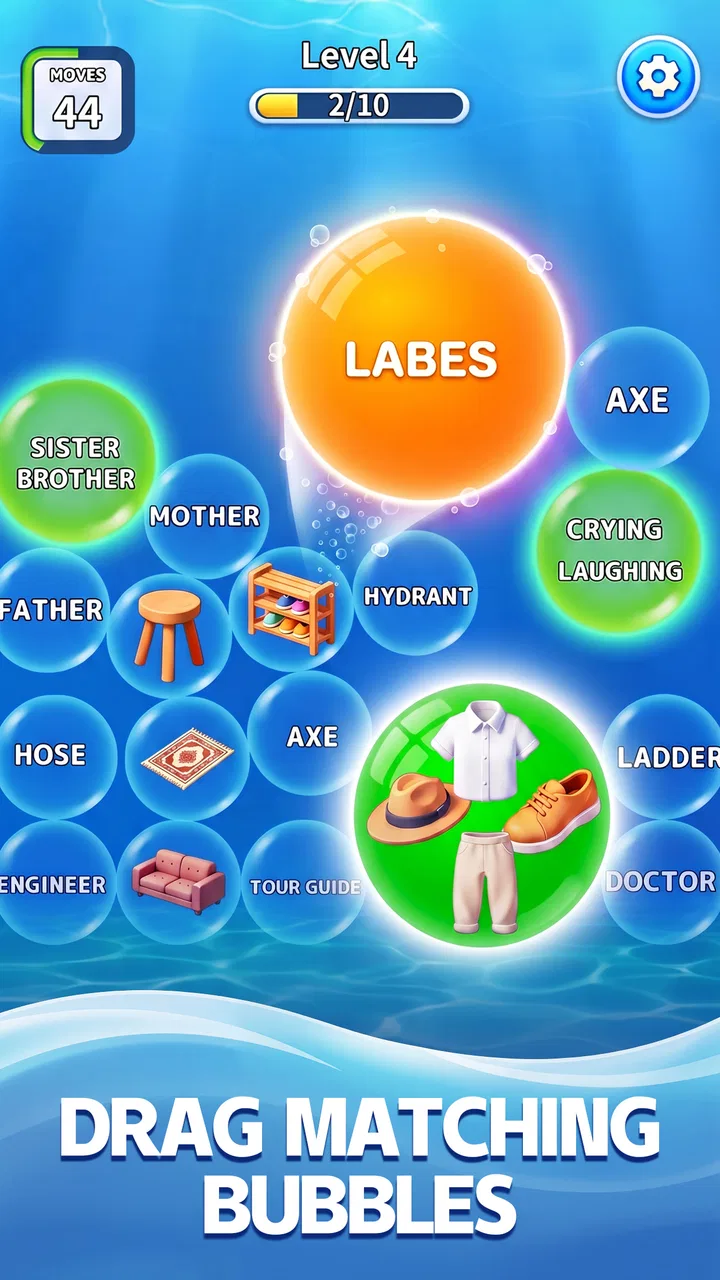
I spent time with Bubble Vocab: Bubble Word Jam, a free word game from BitEpoch that turns vocabulary into a bubble-popping puzzle. The basic idea is easy to understand: words and bubbles share the same play space, and the goal is to make useful choices quickly rather than simply tapping whatever looks attractive. That simplicity makes it approachable, but the real question is whether the game gives you enough reason to keep returning after the first few rounds.
My first impression was positive. It feels designed for short sessions, the kind of game I can open while waiting for an appointment or when I want something lighter than a full strategy game. It is listed for Everyone and runs on Android 6.0 or later, so it is aimed at a broad audience rather than a narrow group of experienced puzzle players. The current version is 1.07, and the game has already passed ten thousand installs with an average rating of 4.9 from more than seven hundred ratings.
How the bubble-and-word format works in everyday play
The appeal comes from the combination of two familiar ideas. Word games usually ask me to search, arrange, or recognize letters, while bubble games usually reward quick visual matching and clearing. Here, those instincts overlap. I have to look at the available bubble arrangement, interpret the word-related objective, and decide which move is useful before the board becomes less convenient.
You May Also Like

 Blood Strike: 2.5 Anniversary
Blood Strike’s Loadouts Turn Every Drop Into a Tactical Gamble
A close look at Blood Strike’s custom loadouts: how fast access to signature weapons reshapes its battle royale rhythm, rewards preparation, and narrows the gap between fights.

 Pandora - Music & Podcasts
Pandora’s Music Is Easy to Start, but Harder to Recover
Pandora’s strength is its low-effort path from a seed to a station. Its weak spot is how much confidence it asks you to place in connection, setup, and quiet recovery.

 8 Ball Pool
 Is Built on Rivalries, Rematches, and Routine
A close look at the rivalries, rematches, shared routines, and unanswered safety questions that turn a quick pool match into a persistent mobile community.

 Samsung Music
’s Quiet Strength Is Playing What You Already Own
Its reach comes less from spectacle than from dependable access to a personal library. That simplicity is both the app’s strongest retention engine and its ceiling.

 AccuWeather: Weather Radar
AccuWeather Review: A Quick, Clear Forecast for Everyday Decisions
For everyday plans, the best forecast is the one you can understand quickly. AccuWeather makes rain timing, radar, and local conditions easy to act on, with a few trade-offs.

 Hill Climb Racing
Why Hill Climb Racing Still Turns Crashes Into One More Run
A tiny car, a bumpy hill and one more upgrade: Hill Climb Racing keeps resurfacing because its simple chaos makes every near-miss feel personal.
More From Our News Desk



That creates a more active experience than a standard vocabulary quiz. I am not merely answering a definition or selecting a word from a list. I am also thinking about position, timing, and the order in which I deal with the board. Even when the individual action is simple, the best move is not always the most obvious one.
The early goals are clear enough to make the game immediately playable. I do not need a long tutorial or a detailed understanding of a complicated ruleset before making progress. That is important for a casual word title because any delay between opening the game and understanding the first objective would work against its strongest quality: quick accessibility.
At the same time, the compact format means the game depends heavily on how well each puzzle communicates its purpose. When I can identify the word task and see how the bubbles relate to it, the experience feels satisfying. When the board is visually busy or the intended relationship is less obvious, the challenge can feel more like searching for the correct interpretation than solving a word puzzle.
Why the first few sessions feel inviting
I think the best audience is someone who enjoys wordplay but does not always want a serious crossword, a timed spelling contest, or a long daily commitment. The bubble presentation lowers the barrier to entry. A player can approach it as a relaxing matching game first and gradually pay more attention to vocabulary decisions as the puzzles become less automatic.
It also works well for families because the age rating is Everyone and the core concept is easy to explain. I could imagine handing the phone to a younger player and describing the task in one sentence. Older players who prefer traditional word games may appreciate the lighter presentation, although they should not expect the depth of a large crossword collection or a dedicated language-learning course.
A realistic use case is a short commute with a few spare minutes. I might play one or two rounds, stop without losing an evening to it, and return later when I want another small mental exercise. That stop-and-start quality is one of the strongest reasons to try it. It does not demand the same attention as a long-form puzzle app, yet it gives me more to think about than a purely reflex-based bubble game.
Progress signals and the value of a clean objective
In a game like this, progress is not only about reaching a later stage. I also look for smaller signals: understanding the board faster, recognizing useful word relationships sooner, and making fewer moves that leave an awkward arrangement behind. Bubble Vocab benefits when it lets me feel that improvement directly through play rather than asking me to study a separate rulebook.
The early goals serve as a gentle test of whether the format makes sense. If I can see why a successful move helps and why an inefficient move creates trouble, I feel in control. That sense of control matters more here than flashy presentation. The pleasure comes from noticing a better solution a moment before committing to the bubbles.
One useful habit is to pause briefly before making the first move. My instinct in bubble games is to clear the most visible option, but a word-based board rewards a wider scan. I get better results when I check the whole arrangement, identify the likely word connection, and then choose the bubble action that supports it. This small change in behavior makes the game feel more thoughtful without making it slow.
Another practical tip is to treat the opening move as information gathering. Rather than judging a round only by whether the first action looks productive, I pay attention to what that move reveals about the remaining board. This is especially helpful when several bubbles appear equally tempting. The strongest choice may be the one that keeps future possibilities open instead of producing the biggest immediate visual result.
That is a non-obvious strength of the format. The game can reward restraint. In a normal bubble-popping title, clearing something quickly often feels automatically correct. Here, I have to consider whether a quick clear supports the vocabulary objective or merely removes a convenient option. That distinction gives the simple controls more strategic weight.
How the difficulty curve affects the rhythm
The difficulty feels most effective when it grows through interpretation and planning rather than through arbitrary complexity. I want the early rounds to teach me what to notice, then I want later challenges to ask me to notice it sooner or combine several observations. That kind of curve keeps the game readable while still giving experienced players a reason to improve.
Bubble Vocab is at its best when I can explain a mistake after it happens. If I lose because I rushed, overlooked a word connection, or committed to a poor order of actions, I can adjust on the next attempt. That is a healthier form of difficulty than a puzzle that seems unpredictable. It turns failure into a useful lesson instead of a reason to close the app.
There is also a trade-off in keeping the concept accessible. Players looking for highly demanding wordplay may eventually want more variety than a compact bubble format can provide. The game’s strength is that it remains easy to start, but that same simplicity may limit its appeal for people who want elaborate word construction, deep dictionary study, or a large competitive ladder.
I would not choose it as my main tool for improving vocabulary in a structured way. The game makes words part of the puzzle, but its primary purpose is entertainment. Someone preparing for an exam, building a formal study routine, or seeking detailed definitions would be better served by a dedicated learning app. Bubble Vocab is more suitable as a playful mental warm-up than as a replacement for deliberate language practice.
What keeps a short game from feeling disposable
Retention in a casual puzzle depends on whether each return feels worthwhile. The strongest reason to come back here is the desire to solve another board more cleanly than the previous one. That can be enough for players who enjoy personal improvement, but it may not satisfy everyone. Some people need a strong sense of unlocks, a visible collection, or a long-term achievement path before a game becomes a habit.
I approached the game with that distinction in mind. The immediate loop is pleasant because I can start quickly, make decisions, and reach a natural stopping point. The longer-term pull is less universal. If my motivation comes mainly from discovering new systems, collecting rewards, or competing against other players, I would probably prefer a larger word-game alternative built around those features.
This is where the pacing matters. A short round should feel complete, not like an interrupted piece of a much longer session. Bubble Vocab has a good chance of working for players who want self-contained bursts of play. It is less convincing for someone who expects every session to introduce a major new mechanic or dramatic progression milestone.
My advice is to judge it by the kind of satisfaction you want. If you enjoy the small victory of spotting a better word-related move, the game has a clear foundation. If you need constant novelty to stay interested, the bubble-and-word combination may feel familiar sooner than a broader puzzle collection would.
Small decisions that make the puzzles more enjoyable
I found that the game rewards a calmer approach than its bubble presentation initially suggests. The colorful, quick-action framing can encourage hurried tapping, but the word element gives me a reason to slow down. I get more enjoyment when I separate observation from action: first scan the board, then identify the likely connection, and only then commit to a move.
I also recommend using a failed attempt as a review rather than instantly repeating the exact same approach. Ask what the first move changed, which option became unavailable, and whether the word objective was misunderstood. This turns a short loss into a compact reasoning exercise. It is a particularly useful method for younger players because it teaches them to explain a choice instead of relying only on trial and error.
For adults, the game can fit into a useful micro-break. I might use it between tasks when I want to reset my attention without starting a story-driven game that will be difficult to put down. The word component gives the break a little mental substance, while the bubble controls keep the interaction from becoming laborious.
One limitation is that the experience will not appeal equally to players who dislike switching between visual scanning and language thinking. Someone who wants a pure word game may find the bubbles distracting, while someone seeking a pure arcade bubble game may find the vocabulary layer slower than expected. That split personality is the game’s identity, but it is also the main taste issue to consider before installing it.
Who should try it, and who should choose something else
I would recommend it to casual players who like word puzzles, visual clearing games, or short challenges that can be played without a large time commitment. It is also a reasonable choice for families seeking an approachable game with an Everyone rating. The free price makes it easy to test without having to commit money first, which suits a title whose appeal depends on whether its particular hybrid format matches your preferences.
I would be more cautious if you want advanced vocabulary instruction, competitive rankings, extensive social play, or a highly elaborate progression system. A traditional crossword app is likely better for clue-based depth. A spelling or language-learning app is better for systematic study. A larger match-style puzzle game may be preferable if your priority is constant visual effects and a broader collection of mechanics.
It is also not the best fit for someone who becomes frustrated when a puzzle requires interpretation rather than an immediately obvious tap. The game asks me to connect the word idea with the bubble arrangement, and that extra layer is precisely what makes it interesting. It can also make an otherwise simple board feel less transparent when I am tired or rushing.
BitEpoch has chosen a focused concept rather than trying to make this a full language platform. I appreciate that focus. The game knows that its value lies in turning a familiar bubble interaction into a word-oriented decision. The result is more distinctive than a basic vocabulary quiz, even if it does not aim to replace the deeper alternatives in either category.
My progression verdict after playing
My overall view is that Bubble Vocab: Bubble Word Jam succeeds when measured as a compact word puzzle with bubble-game accessibility. Its early goals are understandable, its best moments come from planning rather than frantic tapping, and its short-session pacing makes it easy to fit into ordinary life. The progress I notice is mainly personal: I become quicker at reading the board and more careful about the order of my moves.
The main limitation is equally clear. Players who need a rich long-term structure, formal vocabulary lessons, or a constant stream of major unlocks may outgrow it. The hybrid design is clever, but it cannot satisfy every kind of puzzle fan. I would treat it as a focused casual game, not as a complete word-learning solution or an endlessly deep strategy experience.
Still, for the right player, that focus is a benefit. I can open it for a few minutes, understand the immediate objective, and leave after a satisfying challenge without feeling that I have abandoned a complicated campaign. With a 4.9 average from roughly seven hundred ratings and more than ten thousand installs, it has attracted a strong early audience, and I can understand why. The best reason to install it is simple: you want wordplay with a light, tactile bubble-game feel, and you value thoughtful short sessions over a huge progression system.
FAQs for Bubble Vocab: Bubble Word Jam
01What is Bubble Vocab: Bubble Word Jam, and how does the gameplay work?
Bubble Vocab: Bubble Word Jam is a casual word puzzle game that combines vocabulary practice with bubble-popping mechanics. You generally connect, select, or pop letter bubbles to form the correct words and complete each level. The early stages are easy to understand, while later puzzles require more careful thinking, a broader vocabulary, and better planning to avoid using helpful letters too soon.
02Is Bubble Vocab: Bubble Word Jam suitable for beginners and children?
The game is approachable for beginners because its basic controls and word-building objective can be learned quickly. It may also be suitable for children, depending on their reading level and vocabulary development. However, difficulty can vary between levels, and some words may be unfamiliar to younger players. Parents should review the app’s age rating and store information before allowing children to play.
03Can Bubble Vocab: Bubble Word Jam be played offline?
Offline availability can depend on the version of the app and the feature being used. Core puzzle gameplay may work without a continuous internet connection, but advertisements, progress synchronization, updates, purchases, or other online services may require access to the internet. If offline play is important to you, test the game after installation and check its current store description for the latest requirements.
04Does Bubble Vocab: Bubble Word Jam contain ads or in-app purchases?
The game may include advertising and optional in-app purchases, as is common with free-to-download mobile puzzle games. Ads can potentially appear between levels or when you request extra assistance, while purchases may offer boosters, hints, ad removal, or other conveniences. Before downloading, review the Google Play or App Store listing and your device’s purchase settings, especially if children use the device.
05What devices are compatible with Bubble Vocab: Bubble Word Jam?
Compatibility depends on the operating system, device model, and minimum software version supported by the developer. It is designed for mobile play on Android and iOS, but older phones or tablets may experience limitations such as slower loading, reduced performance, or unavailable installation. Check the official store page for the current Android or iOS requirements, available storage, age rating, and the latest update information.
Pros
- Quick word puzzles fit well into short breaks.
- Simple controls make it easy for new players to start.
- Increasing difficulty keeps later levels challenging.
- Bright visuals and playful presentation feel welcoming.
- Useful for practicing spelling and vocabulary recognition.
Cons
- Some puzzles may feel repetitive after extended play.
- Later levels can become frustrating without strong vocabulary skills.
- Hints or extra assistance may be limited during difficult rounds.
- Small text could be harder to read on compact screens.
- Progress may feel slow for players seeking faster rewards.

Bubble Vocab: Bubble Word Jam
Gallery